 SealSQ – QS7001 PQC ready: Smart meters are a central component of critical energy infrastructure and typically remain deployed in the field for 10–20 years, while Germany’s BSI already expects cryptographically relevant quantum computers to emerge in the early 2030s.
For these long‑lived systems in critical networks, classical ECC/RSA cryptography will no longer be sufficient; post‑quantum cryptography (PQC) must therefore be integrated into the architecture of meters and gateways at an early stage.
SealSQ the European secure semiconductor ecosystem
SealSQ focuses on quantum‑resistant security semiconductors and, with products such as QS7001 and QVault TPM, explicitly targets regulated markets like smart energy and critical infrastructures. Through the affiliation of IC’Alps with SealSQ a seamless European semiconductor platform is created, covering everything from secure IP development to ASIC design for application‑specific, safety‑critical use cases.
SealSQ’s platform strategy combines certifiable standard security building blocks with the possibility of developing custom security‑relevant ICs in Europe, thereby reducing regulatory and supply‑chain risks, for example in smart metering, the automotive sector, or defense.
SealSQ – QS7001 PQC ready
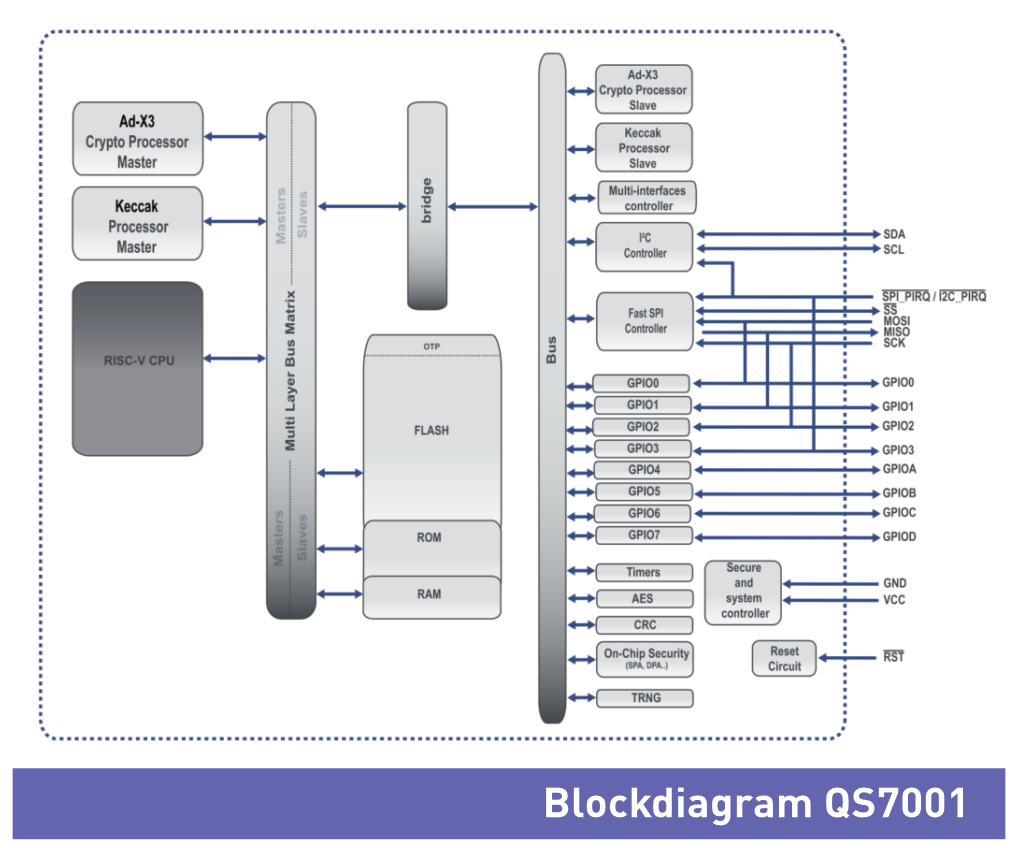
The Quantum Shield QS7001 is a RISC‑V‑based secure hardware platform with a protected 32‑bit RISC‑V core running up to 73 MHz, optimized for use in IoT and energy endpoints. The hardware is designed for, or certified to, Common Criteria CC EAL5+ and integrates a hardware root of trust, secure boot, active shielding, environmental monitoring (voltage, frequency, temperature, light), as well as protection against SPA/DPA/SEMA/DEMA side‑channel attacks.
A look at Germany
In TR‑02102‑1 the BSI recommends ML‑KEM (CRYSTALS‑Kyber) for KEM, as well as ML‑DSA (CRYSTALS‑Dilithium), SLH‑DSA, and hash‑based schemes such as LMS/XMSS for signatures; it also mandates hybrid PQC+classical approaches and at least 120–128‑bit security strength. With the hardware implementation of Kyber (512/768/1024) and Dilithium 2, the QS7001 directly addresses these BSI‑preferred NIST algorithms and, in combination with RSA/ECC, enables the required hybrid crypto agility.
The CC EAL5+ certification basis and SP800‑90B‑compliant RNG implementation are in line with the usual requirements for highly secure, certifiable security modules in the BSI environment (e.g. SMGW security module, PP‑0077).
Together with the IC’Alps design expertise, SealSQ thus offers a fully European, PQC‑capable security platform to transition smart‑metering infrastructures, as part of critical infrastructure, into the post‑quantum era in line with the BSI roadmap through 2035.
Get in touch with us and SealSQ now to review all aspects of PQC in relation to your application and to be optimally prepared. Contact us directly or send us your inquiry here: